September 16th was a great day for me because it was the launch of one of the biggest (and coolest) projects I’ve ever been involved in.
My piece, ‘The Radiance is Everywhere’, a soundscape composition based on an original field recording from the Armenian Quarter in Jerusalem by Raphael Diogo, was featured as part of the ‘Migration Sounds project, in collaboration with the Centre for Migration Studies of the University of Oxford.
Migration Sounds is the first ever collection of the sounds of human migration – all recomposed and reimagined by artists from all over the world – and I am more than grateful to Stuart Fowkes for letting me join in this reimagining.
You can listen to the reimagined and original recordings by searching for ‘Armenian Quarter, Old Jerusalem’, as well as explore this incredible collection of sounds here: https://citiesandmemory.com/migration/
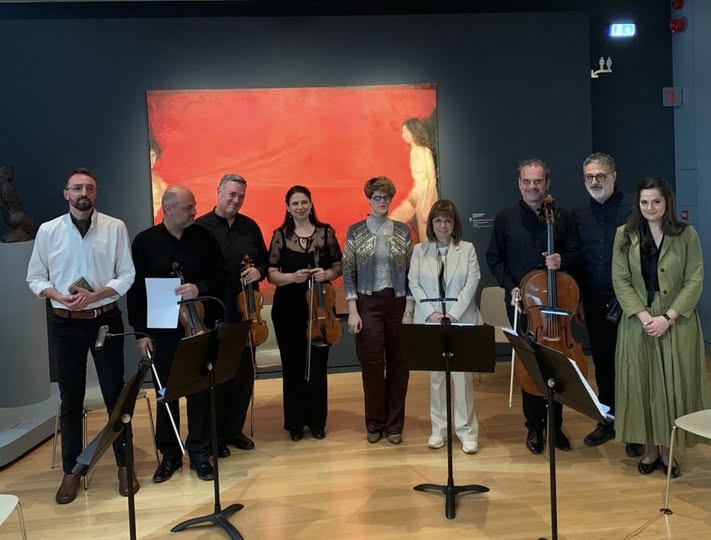
So happy to have been a part of this performance at the Goulandris Museum in Athens as part of the 2nd Sacred Music Festival! An amazing experience and privilege to perform with Lenia Safeiropoulou and the Athens String Quartet.
‘Είδα
πως ήταν μια τέτοια ώρα
σταλμένη από τα πέρατα του κόσμου
για να απλώσει πάνω από τον ήλιο
ένα φως του Παραδείσου.’
Ευχαριστώ όσες/ους ήρθατε να μας ακούσετε την Κυριακή στο Μουσείο Γουλανδρή! ‘ Thank you to everyone who came to see us!
IThe Way - cannot be told.
The Name - cannot be named.
The nameless is the Way of Heaven and Earth.
The named is Matrix of the Myriad Creatures.
Eliminate desire to find the Way.
Embrace desire to know the Creature.
The two are identical,
But differ in name as they arise.
Identical they are called mysterious,
Mystery on mystery,
The gate of many secrets.
- The Tao Te Ching, Lao Tzu
Let me first start by saying that I will never –ever– use the phrase ‘The Tao of Teaching’. Having said that, I would definitely include the Tao Te Ching in the list of required reading for teacher training courses the world over. Had I read it during my training, I think I would have been much better prepared to deal with the despondency, panic attacks and near-meltdown I experienced during my second school phase.
To be fair to my university course, there was counseling available, and much talk of achieving a work-life balance, not burning out, managing time effectively, allowing for mistakes, not letting things (or kids, or headteachers) get to you. And yet that wasn’t enough; it wasn’t enough to ‘manage’ the expectations of the job, to limit the parameters of success or to change how you measured your own achievement. There was something that was forever nagging, no matter how rationally you looked at it, a tiny goblin that jumped out of the piles of clothes that needed washing, or the piles of notebooks that needed marking. It said, in a whisper full of malice: “You haven’t done enough.”
Of course, any kind of training course will involve a variety of learning curves, and learning to accept these kinds of feelings without falling apart or losing your nerve may very well be the sort of ‘baptism of fire’ any aspiring teacher must go through (I might be personalising in this blog, but there are scores of teachers and trainee teachers who know perfectly well what I’m talking about). Yet there is an issue with our fundamental assumptions about teaching which requires a fair amount of looking into. Which brings me back to Taoism.
I’d like to propose that the pressure exerted on teachers (and learners) as well as the feelings of inadequacy they experience both stem from a positivist philosophical premise which is anchored to the pursuit of progress. Progress is the goal. Progress is the unit of measurement. Progress is the key to parental happiness. Progress is what school leaders crave. Progress is the overarching aim of our teaching army. A to B. From here to there and never back again. History marches forward, and so must our children.
Must they? Where to? And what will they do once they get there?
This is the point where it is customary for anyone presenting a ‘radical’ argument to either temper it by moderately claiming that they’re ‘not saying we should do away with all progress’ or to describe with messianic fervour the promised land that lies ahead if only we banish progress (and its proponents) from our classrooms and societies. I’m going to do neither, and I’m going to do both. What’s that? Oh yes, Taoism.
One of the fundamental tenets of Taoism is Wu Wei (無為), perhaps best translated as ‘Action, Not-Action’ or ‘Doing, Non-Doing’. Alan Watts did a thoroughly good and entertaining job of explaining it in detail, and there are myriads of scholarly and/or fashionable books about it. The reason I mention it here is exactly because it can help immensely in reviewing the practice of teaching and learning and be used as a guiding principle for examining the very nature of schooling.
So, what if, instead of progress from A to B, school was all about learning to love the act of learning? To experience feeling good while learning, to want to learn more, to form groups of mutual interest and learn together? What if the actual aim of lessons was to enjoy them, even when they’re challenging, uncomfortable or perplexing? What if there were no learning objectives, goals or outcomes? No SMART targets, nothing other than enjoying the ride and having fun in the process?
Other people have already pointed out the flaws in learning objectives, but most critiques rarely seem to venture deep enough into the structure and foundations of the educational philosophy which gives birth to things like them. Looking at any sample lesson planning document, it is easy to see the kind of forward-motion, target-driven linear approach that is common in learning how to teach. And while I will admit that this is a useful exercise for teachers, perhaps as a step in structuring time in the classroom, it is ultimately limiting, like any closed system; and more often than not, it’s met with resistance, either from the little buggers themselves, or from random technological hiccups, earthquakes, thunderstorms, flying insects, paper-cuts, fist-fights, visits from the headteacher and all other totally unexpected yet normal parts of life.
I am aware that taking away the idea of aiming for learning might be too vague a notion to be seen as pragmatic, as a realisable teaching approach. One way of seeing it would be to understand that acknowledging the importance of setting an aim is not the same and should not be confused with the act of stating an aim. It is attempting to do without having to say (or prove) that we do; to focus our attention not on the purpose or aim of our lessons but on the delivering of them. To try to make our lessons just happen.
Incidentally, if Taoism is too zen for you and you are more wedded to the Western philosophical tradition, Process Metaphysics is another good place to develop your thinking about Heraclitus’s ‘τὰ πάντα ῥεῖ‘ or ‘everything flows‘. It is especially helpful in breaking down the illusion of separateness, the idea that anything can exist in and of itself. One of its basic principles is the nature of objects as interwoven processes and not as fixed individual entities. Think of a diligent student’s pencil case. Or an overworked teacher’s locker.
Barbara Hepworth (British, 1903-1975) – Forms in Movement (Circle), oil, gouache, watercolor and pencil on board
Thinking of everyone and everything involved in school life not as fixed entities but as constantly changing processes allows for flexibility. It allows for teachers to be fallible, for students to forget what they were taught a week ago, for war to break out or pandemics to occur. For lesson time to be experienced as real time, and for this time to not be wasted on zealously attempting to prove that something has been learnt.
In a future blog post, I will be writing more about teaching and time, thrift and our throw-away culture of waste and plenty. For the moment, I will stop here and try and put today’s post in a (squirrel’s) nutshell.
So, the idea that schooling is about teaching students to get from A to B is, I feel, a redundant premise that causes much pain and little gain. If we see teaching and learning from the start not as a never-ending quest to achieve targets and measurable outcomes but as a ceaseless process of exploration, questioning, discovery and yes, joy, schools might become happier places where both the big and little people working inside will not feel inadequate or lacking. There will be nothing that teachers or students will need to do, no mountain peak to reach, no precise knowledge that they have to memorise or transmit.
And from nothing, something interesting might happen.
For three years, from 2012 to 2015, I taught English at a secondary school in central London, in Somers Town, near King’s Cross Station. During my first year at the school -and my first year as a newly qualified teacher in the UK- my classroom sat across two tall, old plane trees and the entrance to one of the local council estates. It was a fairly small classroom, but it was also completely new, that part of the Victorian school building having just been renovated. I liked it, and being extra keen on doing my newly qualified best, I stayed in it a lot, planning and marking ’till late in the afternoon.
I think it was November, one of those dark grey London days that begin in the darkness and never seem to shake it off, not even to host a typical cloud-pale English sky. By 2 o’clock, I had finished my lessons for the day and could start doing all the other teaching stuff that is sometimes not mentioned, like picking up stray pens from the floor, tidying random pieces of paper or inputting data and replying to urgent emails. I leaned on the internal part of the window sill and took to looking at the sky and daydreaming. I lifted the window as much as possible, which was about 10 centimetres, the windows being child-proofed, bolted and locked at the top. To prevent students falling, we’d been told. I then heard the caw of a crow, and saw its black figure fly to a middle branch of the plane tree across the pebbled street. It cawed again, surveyed the street and its immediate surroundings, and flew up to one of the highest branches.
I followed its flight and so found its nest, its home across my workplace.
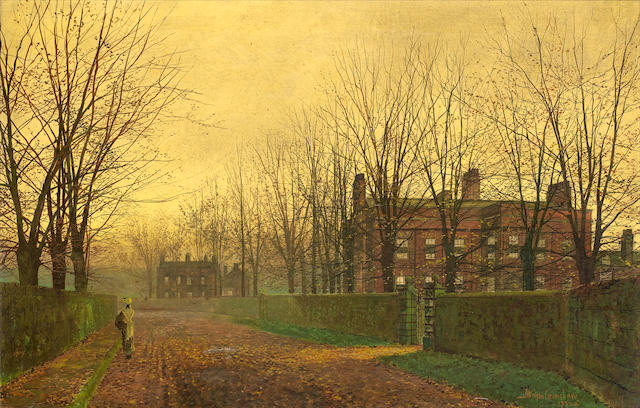
John Atkinson Grimshaw, Autumn, 1883, oil on canvas
For the following weeks, when I wanted to focus on something other than work, student grades, behavioural problems, deadlines, etc., I would look out across the window and just watch for the crow. I paid attention to it, to its flights and caws and movements. One day I had an idea: I would put out some nuts on the window sill and try to get its attention. I got out my 5-minute-break-between-lessons sustenance from my drawer, placed 3 walnuts and 5 almonds on the window sill, put my mouth close to the 10-centimetre gap in the window and made various clicking sounds, the kind a shepherd or a dog trainer might make. I hoped none of my colleagues could hear them or identify where they were coming from.
I waited, but nothing happened. The crow didn’t come. I sat on my laptop and continued planning and answering emails. At some point, I left the room to see a colleague. Sure enough when I came back, the nuts were gone. I felt a strange relief and happiness.
Needless to say that I repeated the ‘feeding ritual’ regularly after that, every couple of days. Again I would wait, but the crow never appeared when I was in the classroom. I figured it could see me moving inside and it probably didn’t trust me enough yet. One day however, it being mid-December by now, it came on its own volition and very briefly alighted on the window sill before flying off again. I hadn’t put any nuts out for a few days.
For the whole of that winter I shared my food with the crow. Mostly, it happened in the afternoon, after lessons had finished. But one day, as was bound to happen, the crow made an appearance during a lesson. The kids in year 9 went nuts. One student cried out in astonishment “What’s that bruv?” and mutters of ‘Allah’ were heard all around (the student body being predominantly Muslim). I said quite calmly that it was a crow, and that it was fine and they shouldn’t be scared because it was my friend. I told the class that I gave it food and it came to visit. I still remember the looks on their faces; they said ‘you’re weird, Sir’.
Yet, something happened that day. Something happened in the students’ minds, not just in their image of their odd, kooky English teacher but in their understanding of the world around the school. Wildness had entered the classroom. Another world, which was this physical, embodied world, had interrupted the lesson.
Sometime in the next few days the students were working in groups on a project, I think on a literary text. In the middle of the lesson a student shouted: “Sir, Sir! Feed your friend!” We all started laughing. I took out some nuts and put them on the window sill. I told the students not to look outside and expect it to come, but to continue working. After about 10 minutes, the crow came and very quickly pecked at some of the nuts. The kids loved it, and carried on working and talking. I think that, some of them at least, might have felt that strange relief and happiness I had felt the first time the crow had come.
Why do I share this story? Well, because it serves as a good starting point, a gateway into the educational vision I want to present in this blog. Squirrel School’s ‘ethos’, if you like. It also lays down some of the major themes that I will be examining: re-wilding the classroom; materiality, the embodied experience of the local environment; curiosity, intrigue and the unexpected; shared emotional experience; teachers’ mental health and stress reduction techniques; curriculum opportunities for meaningful, implicit learning.
The last thing to say is that I also feel that one thing that happened that day was that the students got to know something about me as a person, to see something of my philosophy of life, my approach to the world around me. In effect, I was made into a person, I was humanised by my relationship with a wild animal. Is it not perhaps time to look at ourselves again in that way, to see that a big part of our humanity lies not only in the web of relationships we have with other humans and human-made constructs, but also through how we understand and experience our lives as linked to all the other, non-human lives on the planet? And is it not time we as adults re-learnt about that, together with the young?
So, I guess the first post of the blog should be that the site is up and running, though is obviously not ready yet. Stay tuned for uploads to the poem and translation sections, as well as new posts.





 Chris H. Sakellaridis